
Key takeaways:
- Stripe charges $15 to take a $1,000 stablecoin payment, about half its $29.30 card fee.
- In the EU, PayPal and Coinbase Business don’t offer stablecoin acceptance to local businesses and Stripe has it only in private preview, which leaves Shopify Payments in 24 member states, or BitPay and CoinGate, which both hold MiCA authorization.
- There’s no dispute process for stablecoin payments at Stripe or Shopify, which leaves the shop’s own refund policy as the customer’s only route back.
Do small businesses that accept stablecoin payments need a crypto wallet? Not with most of the setups in this guide. Each is a switch inside a payment processor, and the processor can turn every payment into dollars or euros before it lands in the shop’s balance.
The shortlist depends on the country. A US shop can choose between Stripe, PayPal and Shopify Payments, while an EU shop has Shopify Payments, crypto processors such as BitPay and CoinGate, and a Stripe private preview. What follows compares six providers, prices a $1,000 sale with each, walks through setup and covers refunds, tax and bookkeeping.
Demand is the other thing to size up before any setup work. A Kansas City Fed research briefing published in April 2026 estimated that payments make up less than 1% of all stablecoin use, so for most shops this is an extra option at checkout for a small group of customers, sitting next to cards.
What happens when a customer pays in USDC
What sets a stablecoin apart from bitcoin is that its value is pegged to a regular currency. Circle issues the two this guide mentions most (USDC, pegged to the US dollar, and EURC, pegged to the euro).
Picture the checkout from the buyer’s side. They pick the stablecoin option, choose a coin and a network, then approve the payment in their crypto wallet, the app that holds their tokens. Stripe, for one, sends the buyer to crypto.stripe.com to connect that wallet. Once the network records the transfer, the processor marks the order paid, and the money reaches the merchant later as a regular payout.
Here’s that path in three stops.
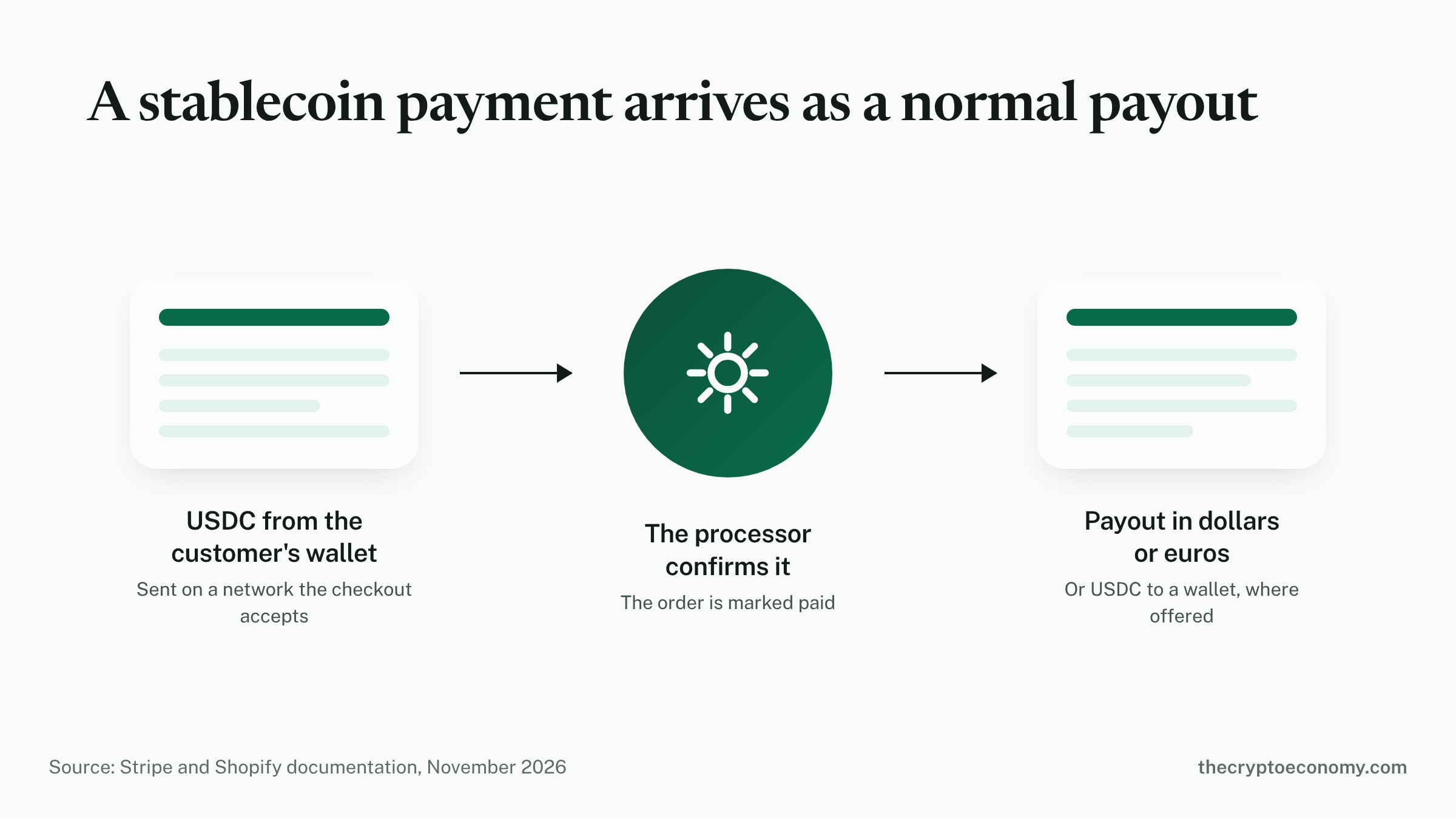
Two details catch first-time merchants out. The network matters as much as the coin, because USDC exists on several blockchains. For USDC payments, Shopify accepts only Base, Ethereum, Optimism, Polygon and Arbitrum, and a customer whose USDC sits on another network can’t use it at that checkout until it’s on one of those five.
Finality is the second detail. Once a transfer is recorded, no card network can pull it back, so refunds and disputes follow different rules.
Who pays the network fee, often called gas, for recording the transfer? Stripe says its stablecoin rate includes “gas sponsorship,” and Shopify’s Help Center says customers aren’t charged gas or foreign exchange fees on USDC payments. On those two, the customer pays the order total and nothing more.
Which providers let you accept stablecoins in the US and the EU
Where the business is registered decides most of the shortlist, because Stripe, PayPal and Coinbase, three familiar names in online payments, open stablecoin acceptance fully only to US merchants. Stripe offers it to businesses in every US state except New York, and to businesses in the EU, Hong Kong, Mexico and Switzerland only as a private preview. Shopify Payments is the main exception.
PayPal’s Pay with Crypto requires a verified US PayPal Business account and, in PayPal’s words, is “available only to US merchants.” Coinbase Business, which offers payment links, invoices and checkouts, is available in the US and Singapore. The table compares the six options a US or EU merchant can sign up for, using each provider’s own documentation as it stood in November 2026.
| Provider | Businesses that can sign up | Stablecoins accepted | How the merchant is paid | Customer disputes |
|---|---|---|---|---|
| Stripe | US, every state except New York; EU, Hong Kong, Mexico and Switzerland in private preview | USDC on five networks; USDP and USDG for US customers | Stripe balance, in US dollars | Not supported |
| PayPal Pay with Crypto | US, verified PayPal Business accounts | About 100 cryptocurrencies, including PYUSD | PayPal balance, in the account’s primary currency | Not stated |
| Coinbase Business | US and Singapore | USDC | Coinbase Business account; conversion to dollars costs extra | No card disputes or reversals |
| Shopify Payments | US except Alaska, New York and Texas; Mexico; 24 EU countries and others | USDC on Base, Ethereum, Optimism, Polygon and Arbitrum | Normal payout in local currency, or USDC to a wallet in some regions | Customers can’t open disputes |
| BitPay | EU through BitPay B.V., listed in ESMA’s register | USDC, EURC, USDP and others | Daily bank settlement, with euros, dollars and pounds among the currencies | BitPay says it eliminates fraud chargebacks |
| CoinGate | EU through UAB Decentralized, listed in ESMA’s register | USDC, EURC and others | Bank payouts in dollars, euros or pounds | CoinGate says there are no chargebacks |
For a store already on Shopify, the Shopify row is usually the shortest way to accept stablecoin payments, since USDC sits inside the existing payments account. A business that sells through its own site or sends invoices has fewer choices in the EU, where the crypto processors are the main path, and those processors are the ones to look up in ESMA’s register.
What a $1,000 sale costs with each provider
Is a stablecoin payment actually cheaper than a card? Against Stripe’s standard US card rate, it is at every provider that publishes a stablecoin price, though the margin varies a lot. Most providers price stablecoin payments for merchants as a percentage of each sale, and the table prices a single $1,000 order paid in USDC.
| Provider | Fee on a $1,000 payment | What the published rate covers | Check before signing |
|---|---|---|---|
| Stripe, card payment (for comparison) | $29.30 | 2.9% + 30 cents per successful US card transaction | International cards add 1.5% |
| Stripe, stablecoin payment | $15.00 | 1.5% of the amount in USD, with conversion to fiat, wallet and AML screening, fraud prevention and gas included | Stablecoins paid through Link have their own rate |
| PayPal Pay with Crypto | $15.00 | 1.5% of the transaction amount since August 1, 2026 | The rate was 0.99% until July 31, 2026 |
| BitPay | $20.25 | 2% + 25 cents when monthly volume is under $500,000 | Lower tiers from $500,000; higher fees for high-risk industries |
| CoinGate | $10.00 | 1% for every processed stablecoin transaction | The plan lists “standard currency exchange” next to the fee |
| Coinbase Business | Not published | A fee on each completed payment, shown inside the account | USDC-to-USD auto-conversion carries its own fee |
| Shopify Payments | No separate USDC rate published | USDC orders run through Shopify Payments and earn a credit per order | The size of the credit isn’t stated |
On these figures, a US merchant that moves a $1,000 order from a card to Stripe’s stablecoin option keeps $14.30 more, and CoinGate’s 1% is the lowest published rate in the table. These are list prices for one order. A volume discount, a high-risk surcharge or a conversion fee on payout can move them, and only the customers who choose the stablecoin option produce the saving at all.
Stripe’s pricing page shows a second stablecoin rate. Stablecoins paid through Link, Stripe’s faster-checkout product, cost 0.8% per successful transaction as a promotional rate through January 1, 2027, plus 0.2% after that, so the same $1,000 order would cost $8 on that route until the promotion ends. Stripe prints the Link rates next to its card rate, with the promotion’s end date underneath.
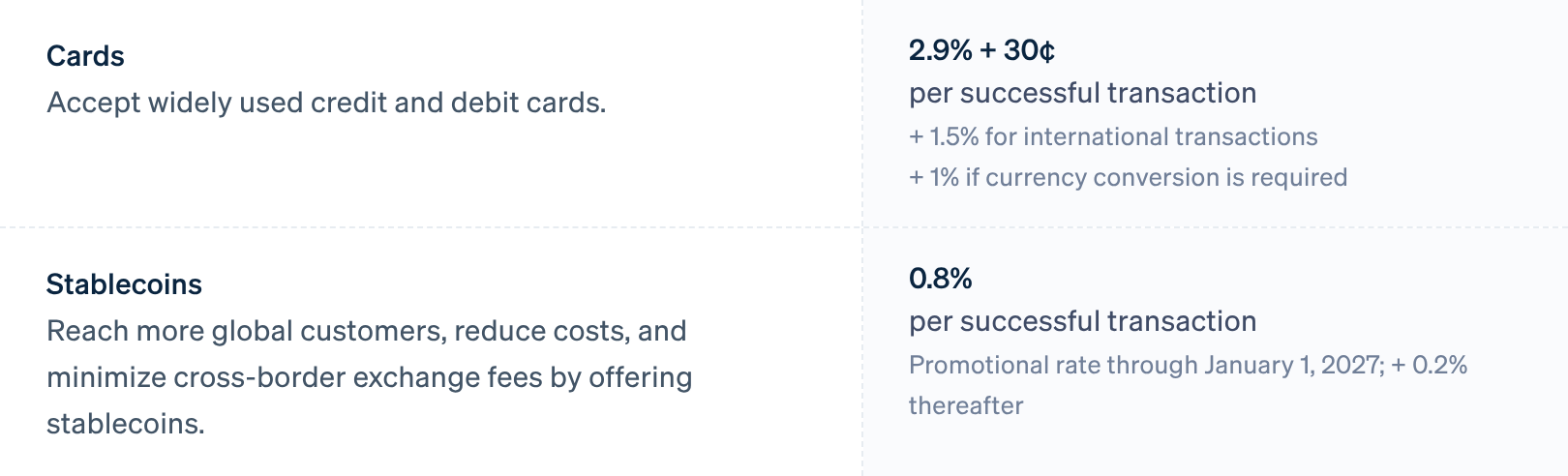
Stripe’s pricing page, Link section, stripe.com/pricing (November 2026).
After January 1, 2027, the added 0.2% takes that route to 1%, or $10 on the same order, which is still below the standard 1.5%. Anyone budgeting for 2027 should plan on that figure, not the 0.8%.
How to accept stablecoin payments, step by step
You won’t need to run a wallet or hold tokens on any of these routes unless you pick a token payout. Each set of steps comes from the provider’s own help pages.
Turn it on in Stripe (US)
On Stripe, you ask first and wait, because stablecoins are a payment method it reviews before turning on.
- Open the payment methods settings in your Stripe Dashboard and ask for the Stablecoins and Crypto method.
- Wait for the review. The method shows as Pending, and Stripe may contact you for more details.
- After approval you can accept USDC payments through your existing checkout. Using Stripe’s dynamic payment methods with Payment Links, Checkout or Elements? Then eligible customers see the option with no code change.
- Before you announce it, note the limits. You’ll work within a $10,000 cap per customer payment, prices show in US dollars, and refunds go out in stablecoins to the customer’s original wallet.
Because the money settles in your Stripe balance in dollars, your books record an ordinary Stripe payout. Payout timing varies by network, according to Stripe’s documentation.
Turn it on in Shopify Payments (US and EU)
Shopify builds USDC into Shopify Payments, so a store already on Shopify Payments in an eligible region doesn’t need an app. Shopify checks who runs the account, too. The account representative needs a home address in an eligible region, and you may be asked for more details about the business.
- Open Settings > Payments in the Shopify admin, then click Manage under Shopify Payments.
- Choose More actions and pick Manage payment methods.
- Under Crypto, hit Verify identity to enable USDC and finish the check, which can leave the account in Pending onboarding while Shopify reviews it.
- Go back to the same Crypto section and activate USDC.
- Pick a payout setting under Crypto transactions, either Payouts in local currency or, where it’s offered, Payouts in USDC.
With local currency, your USDC sales join the normal payout schedule. Three limits are worth knowing before launch. You can’t partially capture a USDC order, customers can’t use USDC for subscription products, and USDC orders can’t take post-purchase upsells.
Turn it on in PayPal (US)
PayPal’s option, Pay with Crypto, is open to US merchants with a verified PayPal Business account, and PayPal lists its Orders V2 API integration as the supported route.
- Confirm that your account is a verified US PayPal Business account and that your checkout runs on PayPal’s Orders V2 integration.
- Turn on Pay with crypto as a payment option at checkout.
- A buyer who picks it goes to PayPal to choose a wallet or exchange account and approve.
- From there PayPal captures the payment, converts it and settles the funds to your PayPal account in its primary currency.
- Refunds go out from PayPal in PYUSD, its own dollar stablecoin.
Buyers can pay with about 100 cryptocurrencies through this route, so it takes coins beyond stablecoins, with PayPal handling the conversion. Payments can be as small as 0.01 USD.
Use a crypto processor such as BitPay or CoinGate (EU)
An EU business that doesn’t sell through Shopify can go through a stablecoin payment processor instead, and both BitPay and CoinGate pay out to a bank account.
- Look up the processor’s EU company in ESMA’s interim MiCA register. BitPay B.V. and UAB Decentralized, the company behind CoinGate, are both listed.
- Open a business account and complete the identity and business checks the processor asks for.
- Pick the coins you’ll take. Both processors let you accept USDC payments, and both list EURC too.
- Set settlement to euros (or dollars or pounds) paid to your bank account, so the business never holds tokens. BitPay settles daily.
- Hook up your checkout or invoicing tool, and try a small payment and a refund before you go live.
Check which networks each processor supports for USDC and EURC at this stage too, since that list is what you’ll show customers on the payment page.
Which stablecoins to accept in the US and the EU
USDC is the one coin that Stripe, Coinbase Business, Shopify, BitPay and CoinGate all accept, which makes it the practical default on both sides of the Atlantic. Stripe also takes USDP and USDG from US customers, and PayPal’s checkout accepts PYUSD, the same coin it uses for refunds.
In the EU, the question is who issued the coin. ESMA’s interim register of e-money token issuers, updated on November 5, 2026, lists Circle Internet Financial Europe SAS for USDC and EURC, Paxos Issuance Europe for USDG and Société Générale’s SG-Forge for EURCV. USDT and PYUSD don’t appear in it. ESMA publishes the register as five downloadable files, with the date of the last update underneath.

ESMA’s interim MiCA register, esma.europa.eu (November 2026).
The absence of USDT and PYUSD matters because of a January 2025 ESMA statement. It told national regulators to make sure crypto-asset service providers stopped making non-compliant stablecoins available for trading no later than the end of the first quarter of 2025, while “mere custody and transfer” of those coins should remain possible.
For an EU merchant, the simplest reading is to offer USDC or EURC and to ask any processor how it treats USDT before switching that coin on. Euro-priced shops have one more thing to check. Stripe presents stablecoin payments in US dollars, with other currencies only in private preview, so an EU business in Stripe’s preview should see how its euro prices appear at checkout, while BitPay and CoinGate both list euro bank payouts.
What US and EU rules mean for a merchant
Both the US and the EU now have stablecoin laws, and both put their main obligations on the companies that issue coins and the firms that provide crypto services. For a merchant that wants to accept stablecoin payments, that makes the provider’s own status the thing to check.
In the US, the GENIUS Act became law on July 18, 2025, as Public Law 119-27. According to the Congressional Research Service summary on congress.gov, only permitted issuers may issue payment stablecoins, reserves must back them one to one with US currency or similarly liquid assets, and issuers must publish their reserve details every month.
From July 2028, three years after enactment, digital asset service providers can’t offer or sell stablecoins from issuers that aren’t permitted. That deadline is still ahead. The act also says permitted payment stablecoins aren’t securities or commodities.
MiCA’s grandfathering period in the EU ended on July 1, 2026, the last date firms running under older national rules could keep operating without a MiCA authorization or a decision on one. ESMA’s interim MiCA register now shows which processors hold one.
| Provider | EU legal entity | Regulator | Authorized | Services listed in the register |
|---|---|---|---|---|
| BitPay | BitPay B.V. | Netherlands Authority for the Financial Markets (AFM) | July 16, 2026 | Exchange of crypto-assets for funds; transfer services |
| CoinGate | UAB Decentralized | Bank of Lithuania | December 16, 2025 | Custody; exchange for funds and for other crypto-assets; transfer services |
| Coinbase | Coinbase Luxembourg S.A. | CSSF (Luxembourg) | June 20, 2025 | Custody, exchange, order execution, placing, order transmission and transfer services |
Coinbase Luxembourg’s authorization covers Coinbase’s custody and exchange services in the EU, while Coinbase Business itself lists only the US and Singapore.
You can check any stablecoin payment processor the same way, by downloading the crypto-asset service provider file from ESMA’s MiCA page and searching for the firm’s legal name, which can differ from its brand (CoinGate’s is UAB Decentralized). A business that plans to hold or move tokens itself, rather than converting through a provider, should take legal advice in its own country first.
Refunds, disputes and wrong-network payments
A stablecoin payment can’t be reversed by the customer’s bank, so every refund is a new payment going the other way, and each provider handles it differently.
Stripe returns the money as stablecoins to the wallet that paid. PayPal refunds Pay with Crypto orders in PYUSD. For refunds on USDC payments, Shopify takes the money from your USDC balance if payouts go to a wallet, or from your Shopify Payments balance, converted to USDC, if payouts are in local currency.
Shopify adds one wrinkle. Customers paying with USDC on Base can get cashback, paid 30 days after the purchase and capped at 100 USDC per transaction, and once it’s paid, a refund can’t exceed the order total minus the cashback.
Disputes change too. Stripe lists no dispute support for stablecoin payments, and Shopify says customers can’t open disputes on USDC orders. That protects the merchant from chargeback fraud, but it leaves the customer with only the shop’s own policy, so write that policy before the first payment arrives. It should cover these points:
- Refunds go back in the same stablecoin, to the wallet that paid, unless the processor sets another route.
- Whether a refund matches the order’s dollar or euro price, or the number of tokens paid.
- How long a refund takes, and who pays any network fee.
- What happens when a payment arrives on the wrong network or for the wrong amount.
- Who the customer should contact, and that staff will never ask for a wallet’s seed phrase.
A seed phrase is the list of words that restores a crypto wallet, and anyone who has it controls the funds. Putting that line in the policy costs nothing and tells customers how to spot someone posing as your staff.
Tax and bookkeeping for stablecoin receipts
US tax treatment starts from one IRS rule. For federal tax purposes, digital assets are property, not currency, and the IRS names stablecoins among its examples of digital assets. Its digital assets page says a business must keep records of the fair market value, in US dollars, of digital assets it receives as payment.
The IRS FAQ adds that income from a payment for services is that dollar value when the asset is received, which for an on-chain payment is the moment the transfer is recorded on the ledger. Any business that received digital assets as payment for property or services during the year also answers “Yes” to the digital asset question on its federal return.
Conversion is the second event to record. If the processor converts on arrival, your books show an ordinary dollar receipt. If you keep USDC and later sell it on one of the crypto exchanges, that sale is a separate transaction, and any difference between its value then and its value at receipt is a gain or a loss.
Side by side, the two payout settings differ most in what you have to record afterward.
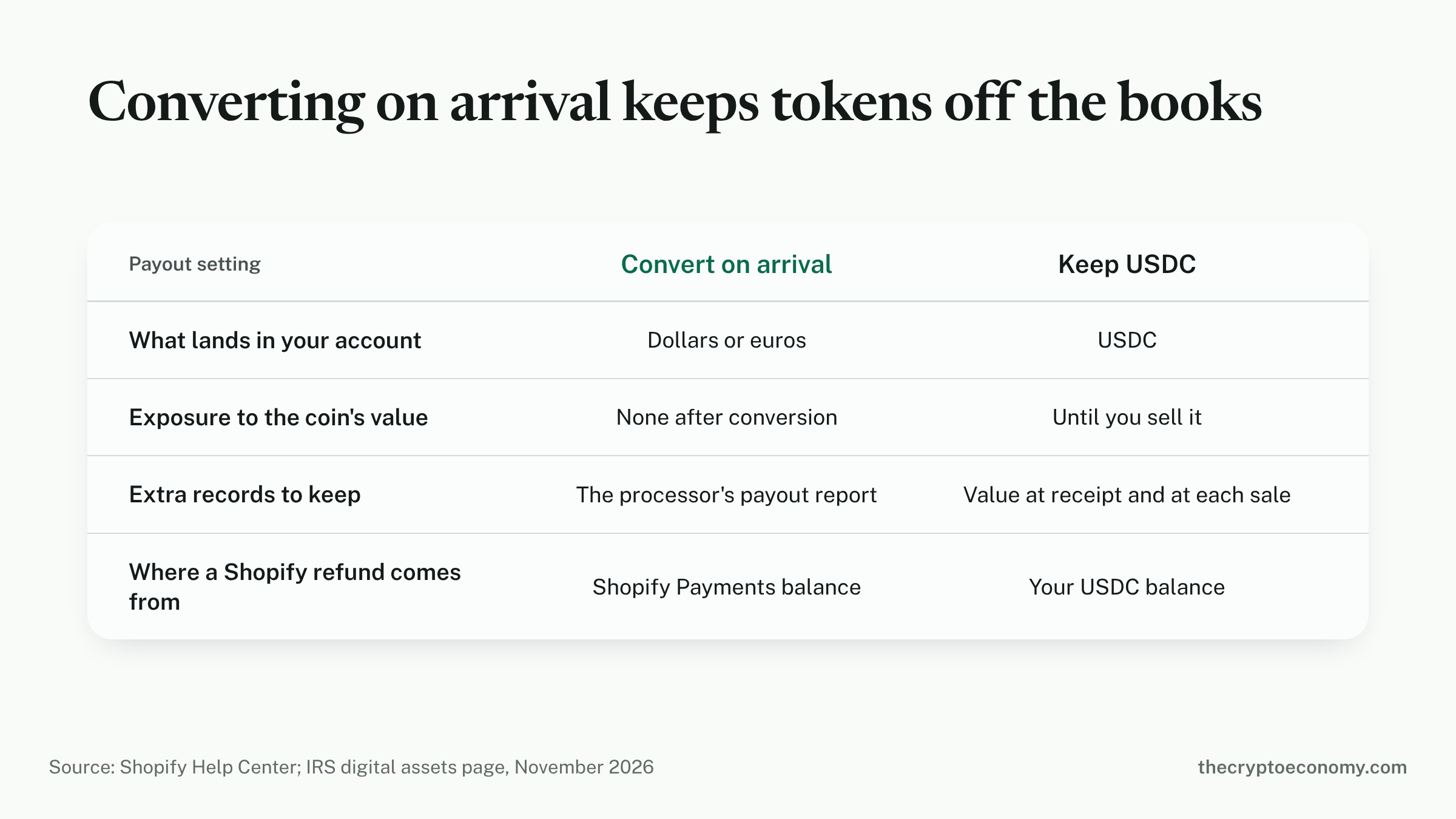
Accountants describe the same split. In an r/Accounting thread on Reddit, one commenter whose firm runs stablecoin invoices through a processor that converts in flight said the payments book as normal currency receipts, and that their auditors signed off after working through the contract and the conversion flow. That’s one firm’s experience, not a rule.
Whichever way the money arrives, keep these records for each payment:
- The date and time the network recorded it.
- The coin, the network and the amount in tokens.
- Its dollar or euro value at that moment, and where the rate came from.
- The processor’s fee and the payout the payment belongs to.
- Any later conversion or swap, with its value on that date.
- The transaction IDs for the payment and for any refund.
EU merchants should confirm the tax treatment with an adviser in their own country, since the notes above cover US federal rules only. Ask specifically how the stablecoin receipt and any later conversion should be booked.
Risks to weigh before you turn it on
The risks of stablecoin payments for merchants are mostly practical ones. Low demand comes first, and it’s mostly a cost of time. Setup, a refund policy and new bookkeeping steps all take hours, and the option may see little use at first.
Depending on a single integration is the second. In an r/ecommerce thread on Reddit, one store owner said they accepted crypto until the only plugin that worked with their store stopped supporting it. That’s one argument for the payment option built into a platform you already run on, such as Shopify Payments, over a third-party plugin.
Holding tokens is the third. A merchant that keeps USDC instead of converting it relies on the issuer’s reserves. Under the GENIUS Act, permitted US issuers must publish their reserve details monthly, so anyone holding a US payment stablecoin can read those reports before deciding to keep a balance. Converting on arrival removes the question.
Before the option goes live, run through these checks:
- Make one small real payment and one refund from start to finish.
- Confirm which networks the checkout accepts, and show them on the payment page.
- Decide who in the business can approve refunds and withdrawals.
- Turn on two-factor authentication for the processor account.
- Record the settlement currency and payout timing in your accounting system.
The test payment matters most, because it shows the payout, the fee and the refund in your own accounts before a customer sees any of them.
Where to start, by situation
If you run a Shopify store in an eligible country, start there. USDC sits inside Shopify Payments, pays out with the rest of your sales and needs no extra app. If you’re a US business on Stripe or PayPal, request Stripe’s Stablecoins and Crypto method or add Pay with Crypto, and set $15 per $1,000 against what your card payments cost today.
An EU business outside Shopify should shortlist BitPay or CoinGate, find the provider’s company in ESMA’s register and settle in euros. A firm that sends invoices rather than running a checkout should know that Coinbase Business’s invoice tool is open only in the US and Singapore, so an EU firm should ask BitPay or CoinGate how invoicing works on their accounts before signing up.
Whichever route you pick, start small. Write the refund policy first, then run one small payment and one refund before you mention the option to customers.
Frequently asked questions
What is a stablecoin payment?
A stablecoin payment is a transfer of a token pegged to the dollar or the euro, such as USDC or EURC, from a customer’s crypto wallet to a merchant over a public blockchain. Most small businesses take them through a processor, which converts each payment into regular currency before the payout.
Do stablecoin payments have chargebacks?
Not in the card sense. Stripe’s documentation shows no dispute support for this payment method, Shopify’s Help Center rules out disputes on USDC orders, and Coinbase Business promises no card disputes or reversals. Refunds still happen, but the merchant sends each one as a new payment, so the shop’s refund policy sets the rules.
Do I have to hold crypto to accept stablecoin payments?
No. Stripe settles stablecoin payments in US dollars, PayPal settles Pay with Crypto in the account’s primary currency, and Shopify pays USDC sales out in local currency unless you choose a USDC payout, which is offered in some regions. You only hold tokens if you pick a wallet payout.
Can a business in the EU accept USDT?
ESMA’s January 2025 statement expected licensed crypto providers to stop making stablecoins from issuers not authorized in the EU available for trading, and USDT’s issuer doesn’t appear in ESMA’s register of e-money token issuers. Holding and transferring such coins remained possible, but USDC and EURC, whose issuer is on the register, are the simpler choice through an EU processor.
How are stablecoin payments taxed in the US?
The IRS treats digital assets, stablecoins included, as property. A business that receives them as payment counts their fair market value in US dollars at receipt as income and must keep records of that value. Converting or swapping them later is a separate transaction that can produce a gain or a loss.